Showing posts with label Downy Woodpecker. Show all posts

Thursday, June 28, 2018

It's a hard life being a bird

Ed Gaillard: birds &emdash; Downy Woodpecker excavating nest hole, Central Park

It's nesting season, and woodpeckers are among the busy birds in Central Park. The the end of May I spotted the female Downy Woodpecker excavating a willow tree at the east end of Turtle Pond.

Ed Gaillard: birds &emdash; Downy Woodpecker excavating nest hole, Central Park

Downys nested there a couple of years back, too. I think the tree is pretty rotten at this point, so the wood is soft enough for a little beak like a Downy's to dig in. The limb she was working on extended over the water, and I watched sawdust float down to the surface of the pond as she worked.

Ed Gaillard: birds &emdash; Downy Woodpecker excavating nest hole, Central Park

The male took part in the digging, too. I don't remember that from last time. The hole got quickly deeper over the next few days, with more and more of the bird disappearing into it as it worked

Ed Gaillard: birds &emdash; Downy Woodpecker in nest hole, Central Park

Finally I saw the female disappear into the nest hole, and then poke her head out. That was about the fourth of June. I figured she must have laid eggs then, and they'd probably hatch about mid-month.

A week later, I noticed that the area of the hole looked different, as if more excavation had been done. And I didn't see the birds, though I could hear the whinnying call of a Downy occasionally on the south side of the pond. Maybe they were mostly keeping in the nest, on the eggs.

Ed Gaillard: birds &emdash; Starling juveniles at wrecked Downy nest hole, Central Park

Unfortunately, no. The next day I saw a gang of about five juvenile Starlings poking around the hole. They or their elders must have raided the nest. Starlings are also cavity-nesters, and they're tough birds that are hard to compete with.

Ed Gaillard: birds &emdash; Northern Flicker in nest hole, Central Park

In the Ramble, there was a pair of Northern Flickers nesting near the bend in the Gill. When I saw them, the female was in the nest hole, and the male was calling from somewhere nearby. I was told that she had been coming out frequently and they'd been seen mating, but now she was staying in the hole. Possibly she was on eggs already.

Alas, once again, a couple of days later Starlings were seen in the nest hole, having evicted the Flickers.

Meanwhile, uptown, the nest of Red-Tailed Hawks at Grant's Tomb ran into some problems. Around the time the young were fledging, the male hawk apparently flew into a window hard enough to break it, and has not been seen since. Then the mother hawk lost an argument with a car and was taken to a rehabber where it was discovered to have some problems from ingesting rat poison. That left three fledglings with nobody to feed them, but mobile enough to be hard to catch; eventually they were caught and brought to rehab centers.

There's a series of posts about the Grant's Tomb nest at the Urban Hawks Blog, June 10, June 11, and June 14; and at the Morningside Hawks blog (I hadn't know about that one before!) on June 10, June 13, June 14, and June 17.

I hear the female has actually been released now, but not the fledglings yet--a single parent would have some trouble feeding three fledglings who can't hunt yet. The young birds are losing important time in learning to hunt.

It's a hard life, being a bird.


Wednesday, November 22, 2017

Winter Is Coming

Ed Gaillard: birds &emdash; Dark-Eyed Junco, Central Park

The days grow short, and it's getting cold. Ducks are coming in to stay at the Reservoir, and now the Juncos are here, so Fall migration is basically over.

I hadn't been seeing too many Juncos this Fall, but a couple of days ago I found a flock of about 60 on a path behind Tupelo Meadow in Central Park, and more scattered south of there in the Ramble. White-Throated Sparrows are still in relatively short supply.

Ed Gaillard: birds &emdash; Downy Woodpecker digging a roost hole

Meanwhile, on Cedar Hill, I've been watching a female Downy Woodpecker excavating a roost hole. When they feel winter coming on, many woodpeckers dig holes in trees to roost in at night, which is what's happening here in this video clip. (By the way, if anyone can recommend simple video-editing tools for Windows, I'd like to hear about them. Doesn't have to be free, but does have to be really easy. Mostly I'd be looking for something to do stabilization better than the YouTube tool.)


Woodpeckers don't reuse their nest holes for winter roosting, which makes perfect sense when you think about what a nest cavity must look and smell like by the time the young have fledged.

She appears to have finished her roost hole now. Hopefully she can defend it from Starlings and House Sparrows.

Happy Thanksgiving! You stay warm, too.

Wednesday, September 2, 2015

Some Fall migration photos

Ed Gaillard: birds &emdash; Proud young Redstart

I'm sorry I've been silent lately. It's been a tiring summer, is all. Also, there hasn't been much going on at once, so it has taken a while for the interesting things to build up to the size of a post.

Still, there's been a steady trickle of Fall migrants, like the proud young Redstart above (a first-Fall male, from the orangy bits), and the very nice male Hooded Warbler below, from Tanner's Spring a couple of weeks back.

Ed Gaillard: birds &emdash; Hooded Warbler, Tanner's Spring

The resident birds have held some interest, too. I was quite surprised to see this scene in the Ramble the other day:

Ed Gaillard: birds &emdash; Grackle killing a mouse

That is a Common Grackle killing a mouse. I have never seen a Grackle stalk and kill prey before.I didn't know they even did that. This one kept chasing the mouse into the waters of the Gill--and occasionally grabbing at it with his beak--until the mouse drowned. Then the Grackle ate part of it, with some difficulty. A Grackle's beak is pretty big, but I don't think it's really suited to tearing up meat.

Other birds dined in a less violent manner.

Ed Gaillard: birds &emdash; Catbird grabbing a pokeberry

I love watching birds eat berries, don't you? Also, woodpeckers are hard at work as always.

Ed Gaillard: birds &emdash; Downy Woodpecker at work

I'll wind up with a couple of more migrants. This shy Canada Warbler was in poor light, but I think it made a nice picture:

Ed Gaillard: birds &emdash; Canada Warbler

And a Great Crested Flycatcher was hanging around Maintenance for several days, giving uncharacteristically close views.

Ed Gaillard: birds &emdash; Great Crested Flycatcher

Monday, April 27, 2015

Domestic arrangements

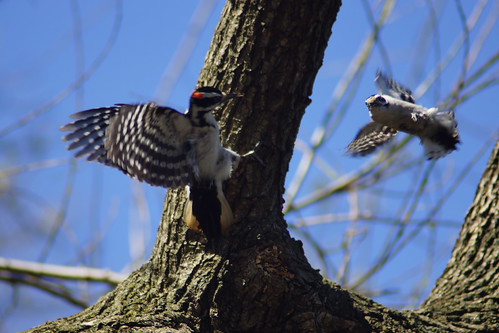
While Spring migration is in full swing, some birds are settling in for nesting season...or trying to. At Turtle Pond in Central Park, a pair of Downy Woodpeckers are excavating a nest hole in a willow tree. Saturday, we saw a Hairy Woodpecker come around...and the Downys chased him away. Elena got a photo of the action.

Downy vs Hairy
Woodpecker dispute (Photo by Elena Gaillard)

Meanwhile, on the pond's shore directly below, a pair of Mallards was browsing. A second male flew in--and then scooted right back out. The male of the pair chased the interloper all around the pond, hanging onto his tail.

Ed Gaillard: birds &emdash; Duck duel
take that, you bounder!

Things were a little calmer away from the water. Singing was everywhere, as males advertised for mates. Passing migrants sang:

Ed Gaillard: birds &emdash; Pine Warbler singing, Central Park
it's been a great Spring for Pine Warblers in the Park.

Resident birds sang as well, some not so musically,

Ed Gaillard: birds &emdash; Red-Winged Blackbird singing, Azalea Pond
whaddaya mean? I sound great!

while others seemed possessed by the spirit of Al Jolson.

Ed Gaillard: birds &emdash; Starling singing, Central Park
I'd walk a million miles for one of your smiles

Thursday, January 29, 2015

Winter woodpeckers and such

There's quite a variety of woodpeckers in Central Park this winter. To start with, there's a pair of Hairy Woodpeckers, who I've mostly seen in the Ramble between the Gill and the Ramble Arch. The male is an exceptionally fine-looking bird.

Ed Gaillard: birds &emdash; Hairy Woodpecker, Central Park
hello, handsome!

Isn't that a good-looking bird?

The hairy's smaller cousins, Downy Woodpeckers, have been all over the place.

Ed Gaillard: birds &emdash; Downy Woodpecker, Central Park
ohsocute!

A few Yellow-bellied Sapsuckers are overwintering, which I don't think I've seen in Central Park before. I'm told they're fairly common at this latitude in winter, however.

Ed Gaillard: birds &emdash; Yellow-Bellied Sapsucker, Central Park
just hanging out

The ones I've seen on my morning walks like to hang motionless off trees. i think they're waiting for sun to warm up the sap.

There are quite a number of Red-Bellied Woodpeckers around. This one likes to stash food in the posts of Laupot Bridge.

Ed Gaillard: birds &emdash; Red-Bellied Woodpecker, Central Park
clever bird

The White-Breasted Nuthatch isn't a woodpecker, but they also stash food in odd places. They're a little more secretive about it, though.

Ed Gaillard: birds &emdash; White-Breasted Nuthatch, Central Park
waiting for me to go away

Tuesday, December 30, 2014

Christmas present; Year-End wrap-up

Christmas present


My other Christmas present, besides the Kingbird, was a spotting scope. I took it for a spin on Randall's island on Sunday. Randall's was pretty quiet.

Ed Gaillard: birds &emdash; Downy Woodpecker, Randall's Island
Downy Woodpeckers were the most interesting land bird I saw that day

The scope worked fine-I saw for the first time Common Goldeneye ducks off in the channel near Riker's Island. I didn't get photos of them--haven't got the hang of taking photos through the scope yet. When I tried, I wound up with shots like this:

Ed Gaillard: birds &emdash; Digibad
digislop

Those are Cormorants off on a channel marker rock probably a mile from Randall's Island. The big one on top is a Great Cormorant, the others are Double-Crested.

Ed Gaillard: birds &emdash; Brant in flight
Brants doing laps

A flock of Brant that was feeding on one of the ball fields with Canada Geese took off just after high tide, flew around the northeast shore area about four times, settled in eastern mouth of the Bronx Kill, and then swam off east.

Ed Gaillard: birds &emdash; Riverscape with Brant
riverscape with Brant


Odds and Ends


The other day, as I passed through the Ramble Arch on my way west, I heard a Carolina Wren singing loudly above. Good morning! He came down to forage--I didn't get much of a photo of him in the brush, but he was quite a cheering sight.

Ed Gaillard: birds &emdash; Carolina Wren, Central Park
an obscure but cheering sight

Today, I spotted a Chipping Sparrow along the path down the Gill source to Evodia.

Ed Gaillard: birds &emdash; Chipping Sparrow, Central Park
oh, Chipping Sparrow, why are you here?

He's very late indeed, but a Chipping did winter here last year. There was a good-looking Sapsucker at Evodia, too.

Ed Gaillard: birds &emdash; Yellow-Bellied Sapsucker, Evodia
Sapsucker at work

The eBird system doesn't think the Sapsucker is late, but I do. Still there clearly must be sap running in that tree somewhere.


Year-end Wrap-up


The Goldeneyes were species number 190 for the year in New York County for me. Barring a Redpoll or something popping up in the Park tomorrow morning, that's my count for the year. That includes a Budgie, which isn't really a bird you should count. Last year I had 176 (including both Budgie and Canary). I had a lot more time to bird the first eight months of the year than previously.

There's not many birds I regret missing this year in Manhattan (though I am a bit sorry I never trekked out to Floyd Bennett Field in Brooklyn to see the Snowy Owl last winter). No Bluebirds, is the main disappointment. There were not a lot of sightings this year. I made a pretty good effort looking, including long silent walks along the top of Inwood Hill. Just not a Bluebird year for me. I missed several Connecticut Warblers--they'd be my nemesis bird if I were a good enough birder to have a nemesis bird. Again, I put a fair effort into looking. I missed the Yellow-Throated Warbler that was around the Tavern on the Green area in Central Park for a week in the Spring. That one I made only two real tries at; I should have tried harder. I didn't see Zelda the Battery Park Wild Turkey this year. Whenever I was down there, she was hiding out. Now I'll never see her again. She had a heck of a long life for a Turkey.

But I saw many more. The best of the year was right at the end, the lovely Couch's Kingbird, a perfect combination of rarity and beauty. But I saw a lot of other wonderful birds, new to me--some rare, some not--Barnacle Goose, Eurasian Collared-Dove, Pectoral Sandpiper, Semi-Palmated Plover, Cerulean Warbler, Kentucky Warbler, White-Winged Scoter, Long-Tailed Duck, Snow Bunting, Red-Necked Grebe... about 30 life birds in the year, which is amazing considering I didn't travel much--almost all of them in New York City.

I figure there's about 35 to 40 species that are regular migrants or frequent visitors here, that I haven't seen yet, so I won't be running out soon--the pace will slow way down since I've seen most of the easier ones. Looking forward to it.

Then there were all the regular birds, the ones I already know. I never see them without enjoyment, never without learning something new. In particular, standing all alone on the shore of Randall's Island while Tree Swallows zoomed around me, courting and feeding and mating, is something I will never forget as long as I live. A perfectly usual bird, seen in a way I never dreamed of. My best moment of the year, even better than the fancy Kingbird.

I'm looking forward to more. I'll have less time for birding in 2015, but I'll be out every chance I get. I have a scope to learn to use, and a hankering to figure out how to photograph birds in flight; and I know more about where and how to look for birds then I ever have. And I'm looking forward to all of it.

Ed Gaillard: birds &emdash; Tree Swallow and nesting material, Randall's Island
Tree Swallow, familiar but brilliant

Friday, July 18, 2014

Middlesex Fells

Readercon's programming started on Thursday evening, so we had a day for non-con-related fun.  We went to Middlesex Fells Reservation, a vast park around a group of reservoirs.  We arrived at the "Lower Sheepfold", and were greeted by a flock of Red-Winged Blackbirds, who roamed the grass undeterred by the off-leash dogs (the Sheepfold is a designated off-leash area).  Further in, Chipping Sparrows and Wood Thrush sang, and a Ruby-Throated Hummingbird flew across the path.

We found a path down to  a reservoir.  Surprisingly, there weren't any waterfowl or shorebirds in sight. Titmice and Chickadees sported in the pines, and we saw two Downy Woodpeckers chasing each other.

Ed Gaillard: birds &emdash; Downy Woodpeckers, Middlesex Fells (Massachusetts)
Dueling Downys

I was expecting nesting warblers, but didn't see any.  Perhaps we  were in the wrong place, or not looking in the right habitat.  We'll be better prepared when we go back next year.

There were chipping Sparrows at the edge of the parking lot when we returned, an adult and a streaky-breasted juvenile.

Monday, July 7, 2014

It's a hard life for a bird, and we're not much help

Sunday, I went to Riverdale to visit my aunts. By the bus stop is a building called "The Arbor", because they cut down dozens of trees to build it. Seriously, every tree on the block. It's a hideous building--the architect thought it would be ever so trendy to give it floor-to ceiling windows, to exploit the excellent views of the henry Hudson Parkway and a church parking lot.

For some reason, nobody wanted to spend several hundred thousand dollars to live in an ugly building with no view in Riverdale, so teh developer went bankrupt and wound up selling the building to Columbia University for cheap, which is unfortunate because otherwise maybe someone would have pulled down the building and tried again.

But there it stands, and of course the floor-to-ceiling windows kill a lot of birds--surprisingly, low rise buildings are the biggest hazard for bird strikes. Intuitively, you'd expect high-rises to kill more, but I guess high rises come into play only during migration.

Anyway I see two or three dead birds a year there, which is a lot since I pass the building at most once a month. Today it was this Downy Woodpecker.

Ed Gaillard: birds &emdash; Window-killed Downy Woodpecker, Riverdale (Bronx) NY
Window-killed Downy Woodpecker, Riverdale (Bronx) NY

Sometimes the follies of people make me angry.

There's an article on Cornell's website about cutting down on bird strikes--note that private homes are the second biggest collision threat to birds--and another one in their "Living Bird" magazine (I think this link leads to a PDF of the article itself).

End of rant, for the moment.


On a more pleasant topic, I struck out again on the Collard-Dove on Sunday Afternoon, but I did get a good look at a Raven flying over, not 30 feet away and maybe 15 feet up. Never seen a wild Raven that close before. Enormous bird, just amazing.

In the native plant garden there were a couple of Monarch butterflies.

Ed Gaillard: recent &emdash; Monarch Butterfly, Hudson River Greenway near 26th Street
Monarch Butterfly, stopping only briefly on his territorial rounds

This was a nice surprise considering what a good job we've been doing at making them extinct with Monsanto's help. Sorry, I said I was going to stop ranting. The parks department planted a good deal of milkweed in the native plant garden, and if you have milkweed, you'll get Monarchs. For now, anyway. There's a lot of information on the net about planting milkweed (here's one article--can't vouch for how good it is, since I'm no gardener), and if you are in a position to add it to your garden, every little bit helps.

I also spotted a Hummingbird Moth. I love those.

Ed Gaillard: recent &emdash; Hummingbird Moth, Hudson River Greenway
Hummingbird Moth--look at that curled tongue

Sunday, March 23, 2014

First Phoebe of Spring

Some birders mark the real beginning of Spring from the sighting of the first Eastern Phoebe. Though I'm not really one of them, I do admit that the first Phoebe does give a certain sense of Springitude to the proceedings.

Elena and I were having brunch and discussing where to go afterwards, and I checked my usual bird resources. On the NYNYBird web page (the web site for a text alert system I don't subscribe to; I don't like texts) was a message from Karen Fung: "E phoebe swampy pin oak. FOY?"

Certainly the first I'd heard of. So we went to the Ramble, intending to check the Swampy Pin Oak. That needs a new name, by the way, since the big Pin Oak was brought down in the aftermath of Sandy, but I digress.

We came up Cedar Hill, spotting a male baltimore Oriole there (maybe the one who wintered around Evodia), and entered the Ramble through Maintenance Meadow, and...

Ed Gaillard: recent &emdash; Eastern Phoebe, Central Park
Phirst Phoebe

...there it was, our first Phoebe of the year. Ah, Spring!

Evodia was normally busy with the usual birds, including the female Baltimore Oriole. There were a lot of Downy Woodpeckers around.

Ed Gaillard: recent &emdash; Downy Woodpecker, Central Park
Downy glaring at an incoming house sparrow

We spotted another Phoebe a little south of the Humming Tombstone, and also our first Hairy Woodpecker of the year (life bird for Elena, and 82nd species of the year for me).

We looked for Woodcock in the Humming Tombstone area, with no luck, but at Tupelo Meadow we saw someone peering intently into the fenced area around the big Tupelo tree. She made a complete circuit, and then suddenly a football with wings burst forth from the middle of the area and flew south toward the Gill. So there are still Woodcocks around.

At the east end of Tupelo Meadow is a tree dark with sap. Two Yellow-bellied Sapsuckers were disputing ownership.

Ed Gaillard: recent &emdash; Yellow-Bellied Sapsucker, Central Park
winner and still champeen!

See how his crest is up? That's an agitated bird.

On our way back out through Maintenance, we saw this Swamp Sparrow in the meadow.

Ed Gaillard: recent &emdash; Swamp Sparrow, Central Park
Spring in his step

That's Spring all over.